How To Make $1M At Any Age
Joe Liemandt was worth $500M at 28. His playbook for making your first $1M: find a costly problem a company wants solved, then make an offer so good they’d feel stupid saying no.
Founders School
3 min read
Joe Liemandt was in his mid-20s when IBM agreed to pay his company, Trilogy, $25 million for its software.
He landed a deal that size by focusing on three things:
1. Finding a problem that's costing a company a fortune.
2. Making sure it's a problem the company cares about solving.
3. Charging a premium price that they would feel stupid saying no to.
Here's how you can use his strategy to make your first million: exactly how he thinks about each step, for founders on the way to their first million.
But first, who exactly is Joe Liemandt, and why should you listen to him?
Joe dropped out of Stanford to start Trilogy Software in 1989, and it quickly became a major player in the enterprise software space.
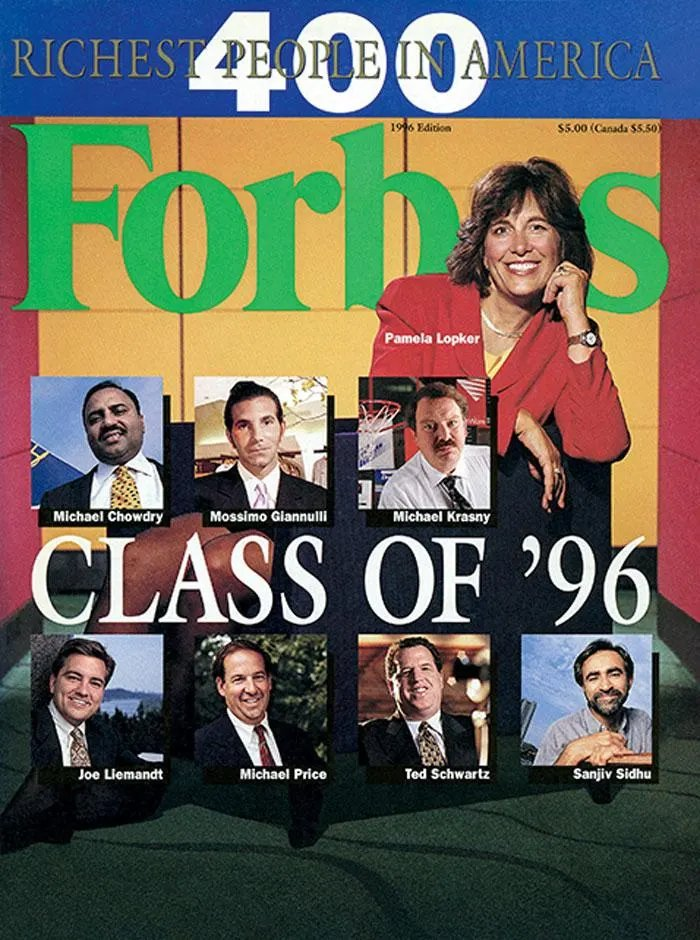
In 1996, he was the youngest self-made person on the Forbes 400, with a net worth of $500 million.
These days, he's betting big on education and has become the principal of Alpha School.
Recently, our Founders School students had five days to prepare to pitch him their business ideas.
His advice came down to three steps:
1. Start with a problem that's already costing someone a fortune.
Joe attended Stanford because it was the center of AI development in the '80s.
He took a class from a professor known as the father of expert systems, learned everything he could, and came out convinced he could build one of these systems himself.
One thing he noticed about the AI companies around him was that a lot of them weren't doing well, because they were built around what was cool to work on at the time.
Not what a customer would pay for.
So he asked a different question:
What could he build that companies would pay a ton of money for?
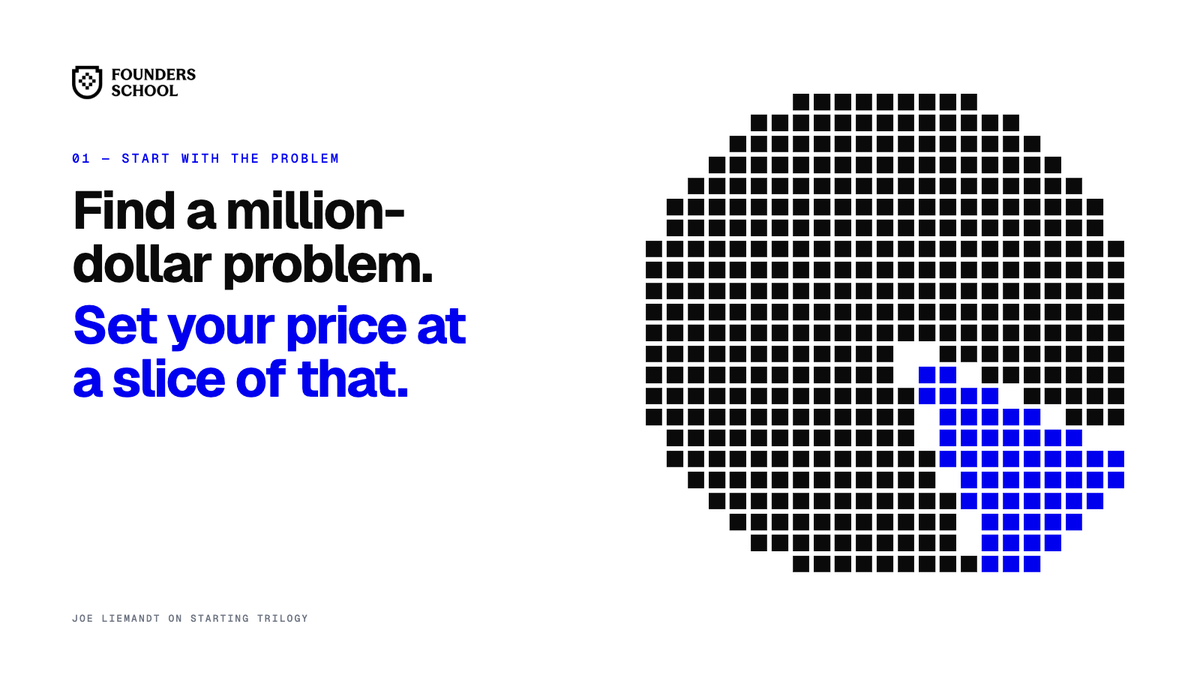
He found an article saying that solving one particular problem was worth about a million dollars a day to companies like Hewlett-Packard, IBM, and AT&T.
"Okay, that seems like a lot of money," he remembers thinking, "and if I can solve that problem, they're going to give me some of that money."
If a problem costs a company $1M a day, asking for a portion of that isn't a stretch.
You don't need a huge audience or a clever product.
You just have to position yourself next to an expensive problem.
2. Make sure it's a problem they care about.
One student pitched a service helping small retina practices get paid for every injection they give.
It’ll cost every practice $7,500 to set up, plus a $5,000/month retainer.
Joe didn't push back on the price.
Instead, he asked the student whether this was the problem the customer cared most about solving.
Businesses don't have time to fix everything.
They can only focus their attention on 2-3 problems at a time.
If your solution doesn't solve a painful enough problem, you're rarely a priority.
So before you develop an offer, list everything that's a problem to your customer and be honest about where your solution ranks.
3. Charge a premium price they would feel stupid saying no to.
Joe credits Alex Hormozi's $100M Offers for his favorite pricing rule.
You should "be able to create a product that could be 10 times more expensive and the customer still thinks they're stupid if they say no."
Long before Alex wrote $100M Offers, this was the principle he used to build Trilogy.
He priced at 10 times what everybody else charged and still made companies like IBM feel like they were getting a great deal.
If you got the first two steps right, a high price isn't greedy. It's still a fraction of what the problem costs them.
Here's how you can apply this to your business:
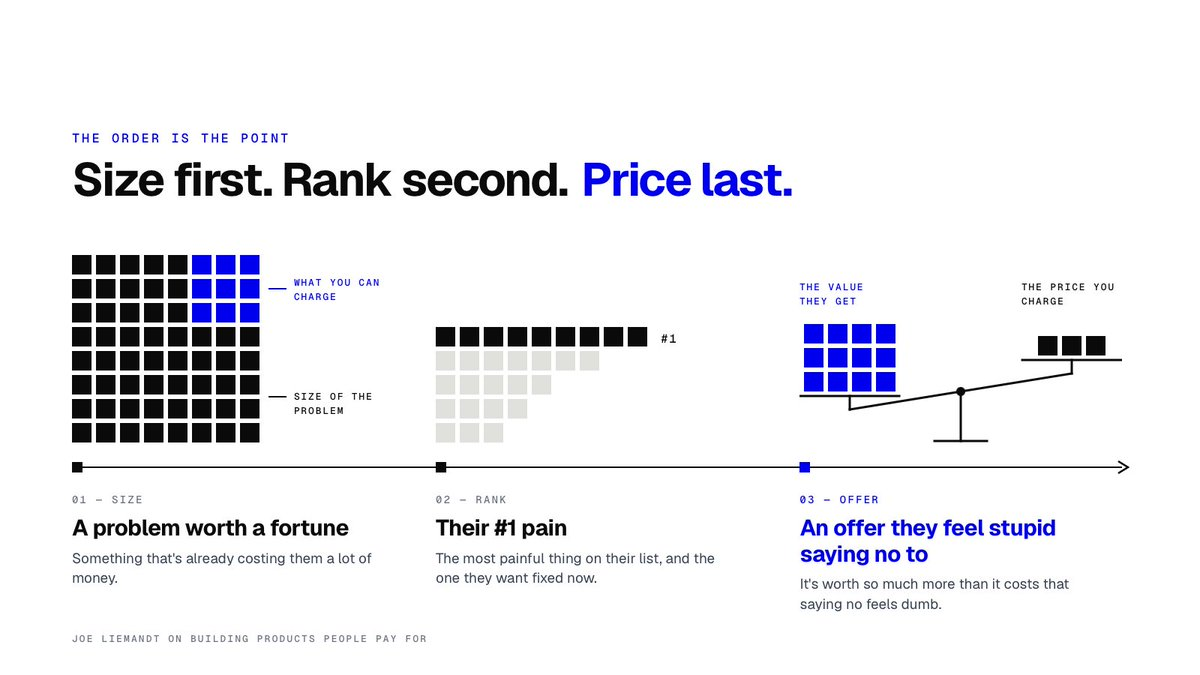
First, understand how big the problem is, then how much the customer cares about solving it.
Once you understand that, think about charging a premium price for your solution.
A lot of founders start with a price that feels fair to them, then go looking for someone to pay it.
Joe went looking for the biggest bill he could find and worked backwards from there.